01: Preface: a Historical Soul-Redemption-&-Resurrection Phenomenon
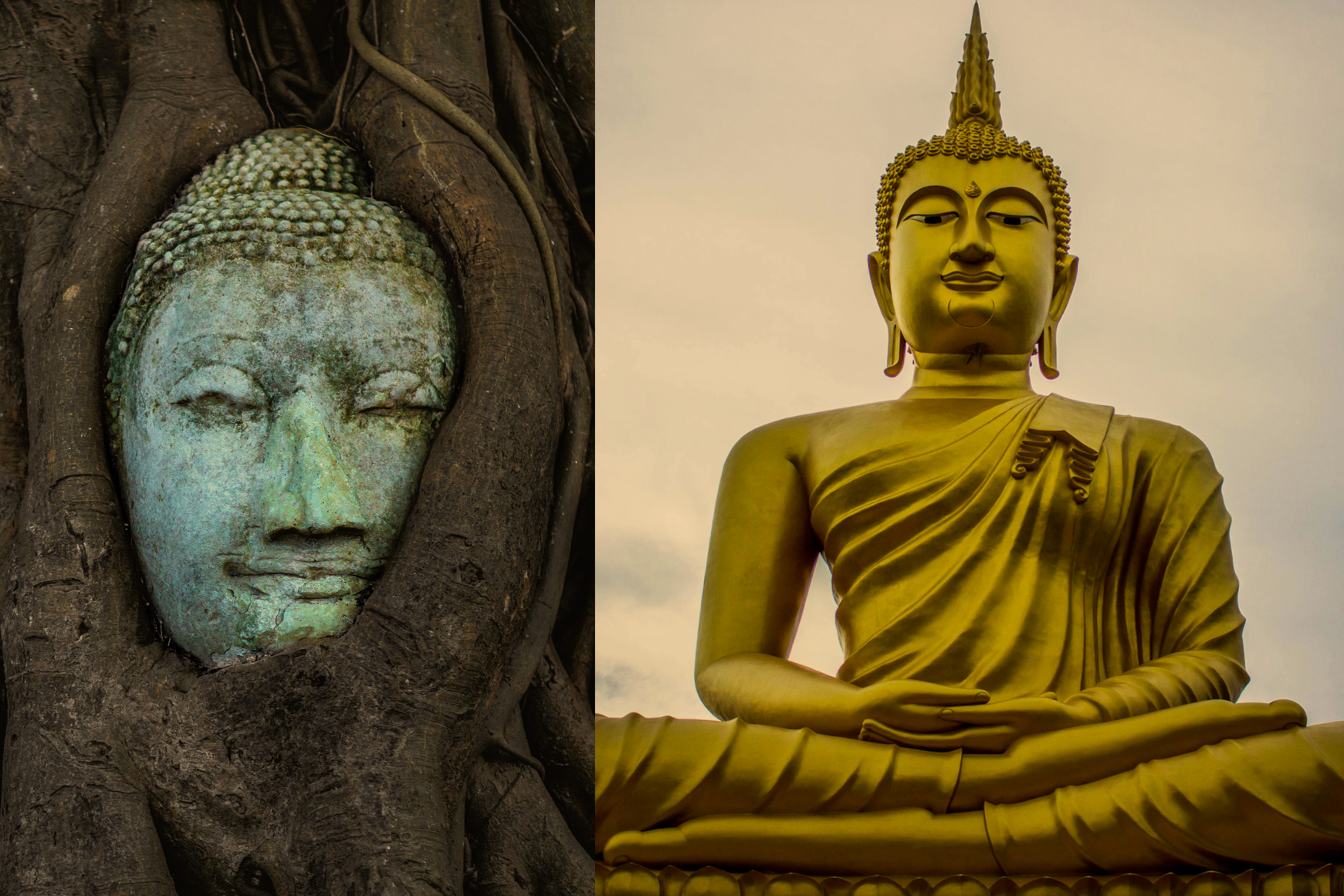
Note: the photos above are not those of the actual statue.
The Holy Story for Oh Holy Fat™
In the mid-1950s, just outside a modest temple right in my motherland, Bangkok, Thailand, there stood an open shelter with only a flimsy tin roof overhead. Under that roof sat a weathered, large Buddha statue, roughly 10 feet high and about 12 feet across. Aside from its generous size, there was nothing particularly striking or remarkable about it; it resembled the many ordinary Buddha statues made of ordinary stucco with a colored glass that existed everywhere in the area. All that anyone seemed to know was that it had been resting there for at least 20 years, patiently waiting until the monks were able to build a Wiharn, the temple’s main hall, large enough to house it.
Then when the great Wiharn had been completed and prepared, while the monks were carefully hoisting the statue from its pedestal, several slings suddenly snapped!! And the statue tumbled to the ground, causing portions of the stucco to chip and crack away. Although the accident was a tremendous shock, later, when the monks peered into the fissures, to everyone’s absolute astonishment a golden Buddha was revealed within!
After all the “shell” had been carefully removed, what emerged was a Buddha statue crafted entirely of gold, composed of 10 parts that fit together with exact precision yet could be disassembled by the small key also discovered, encased in the plaster at the base. Thanks to that thoughtful design and the presence of the key, transporting the statue to the Wiharn this time proved far easier and less precarious than on the first occasion.
In its proper new “home,” the now reassembled golden Buddha began to receive the proper honorable protection, recognition, celebrations, and reverence it had long deserved. Likewise, the research into its origin and history also began to receive renewed attention, respect, and careful scholarly study.
What was discovered was that this statue had been constructed roughly 500 years before the day its “real identity” was revealed, and it was crafted entirely from solid, pure gold, weighing astonishing 5.5 tons! It was also uncovered that, prior to arriving at its present location, the statue had already been relocated twice, moved from earlier capitals whenever Siam’s (the historical name of Thailand) royal dynasties changed. Interestingly, apparently, the Buddha’s real identity continued to be concealed by the protective “shield” until the proper Wiharn was established as its proper “home”.
Although the rest of its history was not clearly documented, the historians discovered enough to conduct proper studies and concluded that between 1765 and 1767, when Burma, Siam’s next-door country, attacked Siam’s old capital Ayutthaya, its temples and golden Buddhas were the most heavily targeted. Therefore, because of this statue’s unusually large size and prominence, and in order to safeguard their most vulnerable, most valuable, and most revered object from being attacked or stolen, the monks plastered a careful cover of stucco around it to disguise its true form. Although the raids had long since ceased, nobody knew about the disguise, for understandably the protection plan and the coverup were kept strictly secret, and the monks who had carried out the work of genius had already long passed away.
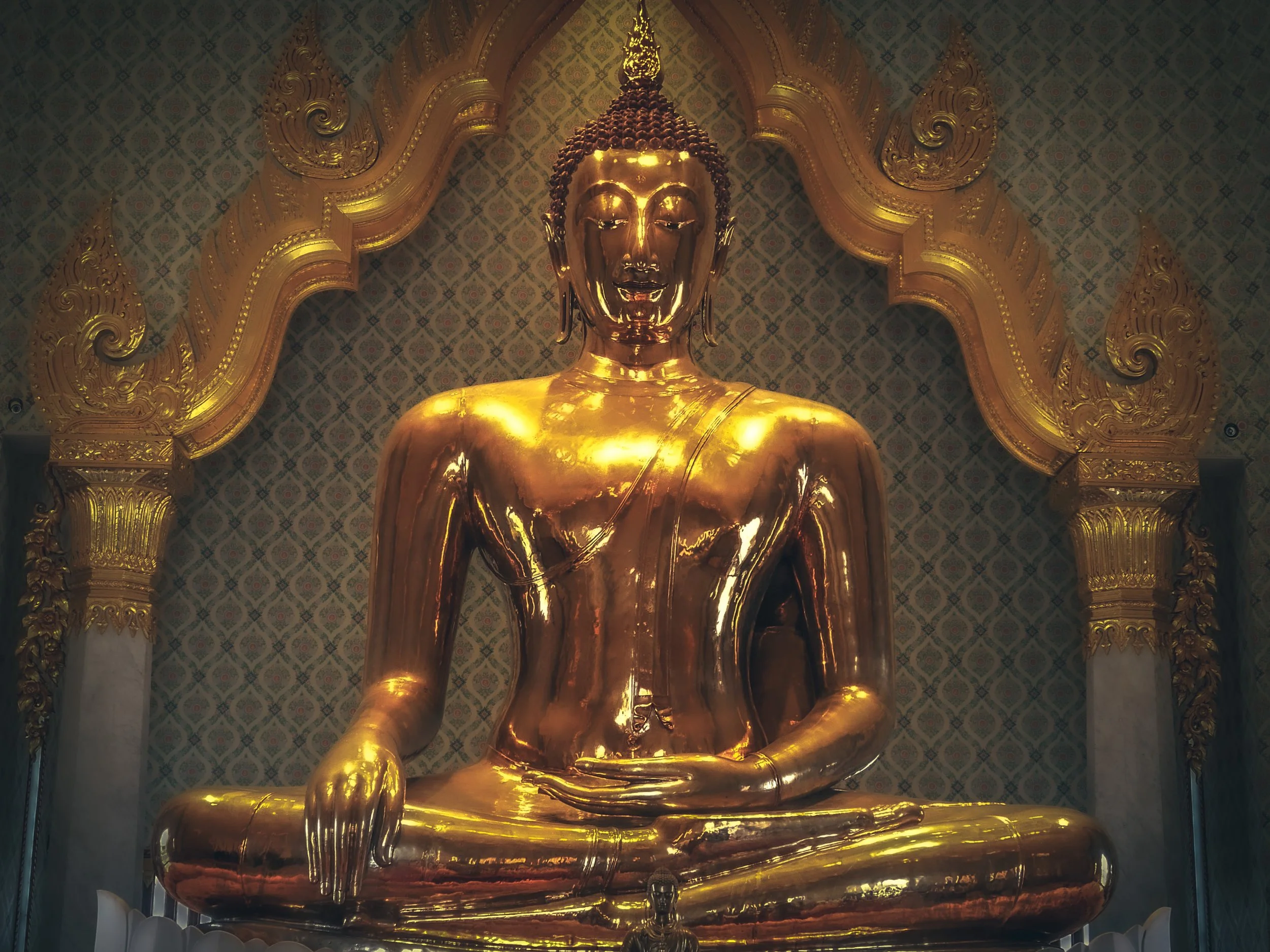
This is the photo of the Golden Buddha at Wat Traimit in Bangkok now.
As a 5.5-ton miracle, this golden Buddha has been recorded as the largest golden Buddha in the world {thus far}. Many Buddhists deeply revere it, and countless tourists from across the globe consider it a must-visit attraction. Personally, I don’t believe that it is merely the material wealth of the statue that has drawn so many admirers. I believe it is more likely the statue’s rich story and the remarkable history of how its Essence was protected, hidden, and eventually discovered that have made this figure one of Thailand’s—and Buddhism’s—greatest treasures! That combination of material brilliance, spiritual significance, and storied past is what makes people long to be near it, to cherish it, to honor it, and to celebrate its presence.
(photo credit: กสิณธร ราชโอรส)
Why this is a perfect holy Preface story for Oh Holy Fat™
First of all, because I’m always genuinely in awe of this remarkable phenomenon! And secondly, and more importantly, because this very phenomenon essentially narrates “the {holy} plot” of my entire memoir!
Here are the parallels:
1. The Buddha’s size was so vast it could not be housed—no room, no hearth, no shelter that would hold its breadth. So it stood outside: exposed to weather, unattended—a solemn presence without a proper place. That was me for a long while. Born with a body that carried its weight sovereignly, but in a culture where most bodies were smaller, mine treated as “other”. Since I came into existence, my flesh and I were nudged to the margins. If you can, imagine the hollow ache of being told, most often, by looks and silence, but other times, with cruel utterance, that you do not belong. Imagine the slow weathering of spirit that follows when there is nowhere to set down your hunger for welcome. That empty-room feeling—unseen, unaccepted, always outside—was the atmosphere I breathed for almost my whole life since I can remember.
2. I cannot think of a more perfect symbol for one of the important roles that my excess weight served than the stucco that hid the true gold Buddha within—an “armor” painted dull and rough to ward off harm. The Buddha’s core was burnished light: radiant, precious and wholly valuable. I too was taught, softly and with force, that to be such light was unsafe. My excess weight too was stucco hiding a golden Buddha to ward off harm. So I built a veil to muffle the shine, a shell to soften who I might be. When strangers and those who I thought were friends looked away, the stucco held. In the world’s glare it calls for hiding: Look past me, I am nobody. In truth, it dimmed the very radiance it sheltered. Sometimes I chipped away and the gold flashed. Attention bent like too strong of a sunlight and panic froze me. I pasted the stucco back on, heavier—a message: don’t notice, don’t approach, don’t hurt what’s inside. But the stucco wasn’t only armor. It was scaffolding against loneliness, a buffer against expectation, a harbor for grief. When the time comes I’ll tell those stories. For now I’ll let this be the beginning.
3. What about the monks who were entrusted with guarding the Buddha’s most sacred form—so precious, so vulnerable, so luminous for them? When the world feels dangerous and our heart trembles, what wiser, more innocent act could there be than to gather every ounce of cunning compassion to keep that sacred safe? These monks are the guardians of the Buddha’s soul. Their methods—veils, shells, hidden chambers, secretive devotion—are not clever tricks born of malice but the tender strategies of survival and devotion. When love trembles with fear, it does not expose itself carelessly; it shelters, it fortifies, it invents ingenious ways to preserve what cannot be replaced. This impulse is ancestral and holy. I see myself in their stead now: the parts of me that build armor, that hide beneath layers, that create relentless rituals of defenses. They are not the enemy. They are the firefighters of my inner house, rushing into flame with tools fashioned from necessity and dedicated care. Now, my gratitude dissolves what used to be blame. To indict “the monks” is to condemn the very capacity to protect what we cherish most. Instead, I now bow to their devotion. I thank the tender architects of my safety—those inner sentinels who learned to defend me when the world could not. In this recognition, through this story, I reclaim their genius with deep compassion and immense gratitude.
4. Let’s look at the sling that snapped, the sudden break that caused the statue to fall and the shell to crack open—the very event that eventually led to the treasures being revealed! Which means the break down led to the redemption and the resurrection that is like a rebirth! Wow! How that “break” helped make the Buddha “whole” again! What a striking phenomenon—and such a potent metaphor for many of us, trauma survivors who naturally learned to self-protect. We build “walls” and don “armor"; we rely on external things and behaviors to shield our vulnerable inner world. And yet, without that fall and that rupture, the hidden treasures lying beneath the protective structures we were forced to create for survival might never have been uncovered. This phenomenon represents a lot of my experiences: the pain that once pushed me toward suicidal despair and the overwhelming physical symptoms that finally forced me to stop, turn back, and make a decisive, life-changing shift! The shift that led me to rekindle with my Soul—my Golden Buddha! Without the shattering, It might be forever buried and never be found. The anguish that bends the body, the despair at the edge, the unbearable symptoms that force a halt—these are the cracks that let light in. Pain can wake us; collapse can point to the only place left to look: inside.
5. This Buddha is made of parts—each a pilgrim seeking wholeness. This directly reflects the Internal Family Systems. Splinted limbs and threaded seams whisper of exiles, protectors, managers—each shaped, distinct, carrying its own history and tenderness. Between the parts lies a key, small as a promise, heavy as a vow—more metaphor than metal. Turned, plates align and the sculpture becomes a sovereign, aligned whole body; withdrawn, joints sigh and pieces resume their separate songs. The key thus stands as emblem of Soul—a quiet Center that gathers Parts or releases Parts’ burdens. Soul is a harmonizer, the presence that assembles with gentleness. With Its present, edges soften, protectors relax, exiles are welcomed and parts find their authentic rhythms. Absent, parts rattle apart, each claiming the stage. The tiny, deliberate key teaches this: the power to unify is always there—subtle, sovereign and sacred. I see the key as the Buddha’s wisdom made practical: a tool reminding that wholeness is tended—knowing when to lock for safety and when to unlock for trust so the “Parent'“ can gather its scattered children and teach them to rest. The key is this Buddha’s Essence, its Soul: when present, It assembles, harmonizes; when absent, parts polarized with burdens, and fall apart or hide. That small lock carries the genius: the power to unite what was once parted and hidden.
Now, why must this story be told today?
On the very day this story found its voice—Easter Sunday—you might assume that I myself determinedly chose it for its holiness, that no other day could be more fitting. Well, even I am surprised by how it unfolded on this particular day as the timing of it feels like a small yet personal miracle and phenomenon in itself, too.
Here’s what happened: I personally believe in numerology so I’ve long listened to numbers as if they were old friends. Months ago they whispered that April 5, 2026 would be an auspicious moment to begin this memoir, so I shaped my plans around that quiet summons. Then, only last week, the calendar revealed to me another layer: that same date fell on Easter—one of the Holiest days of all!
In that instant the sense of choice slipped away. It felt less like my decision to make and more like a call for me to serve as a support for the story to declare its own resurrection. Am I actually surprised? No, not really. After all, this is a memoir of Redemption, Resurrection and Rebirth that I was called to tell; of real suffering and real healing that need to be told—with the purpose to Heal Forward. Therefore, I’ll be in my rightful place: a channel of it.
Reflection Prompts:
Now, since I’m a devoted believer in healing magics and in miracles that arise through honest reflections, I’ve prepared some gentle reflection prompts for you in my next post. Please visit “Story 01.a: Reflection Prompts on the Preface Story” to find them and to take your journey inward. And while you’re doing your reflections, please know that I am there with you!
With love,
Gaia